From Prompts to Partners: 180 Days on the Engineering Frontier

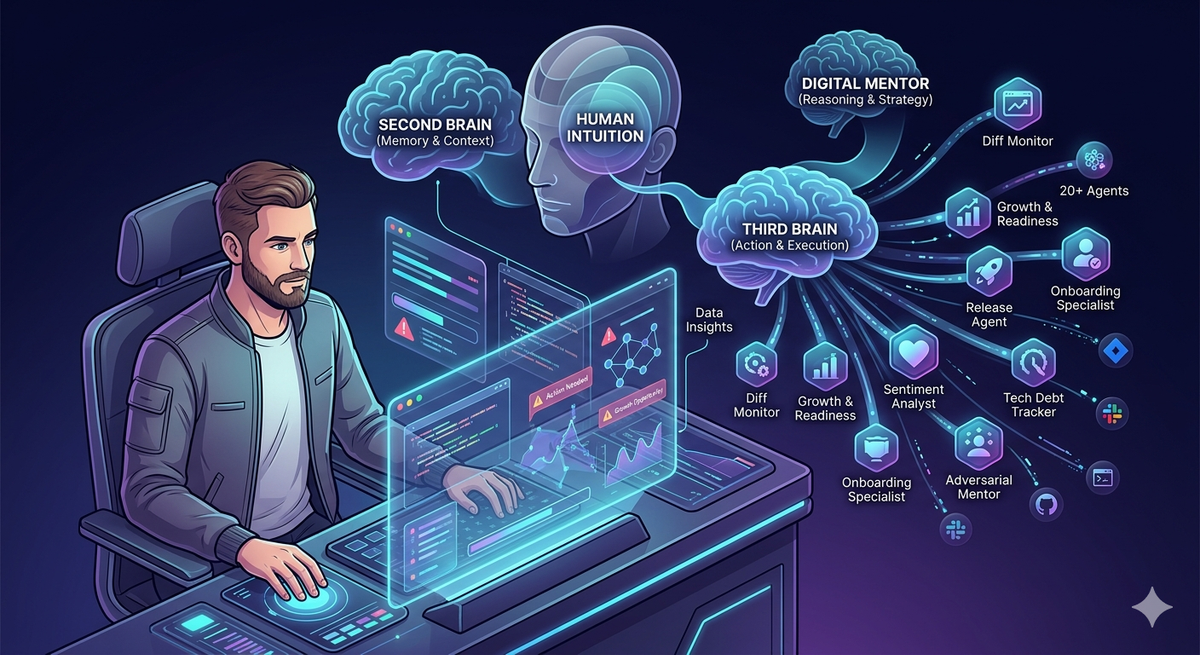
Six months ago, I thought I understood the trajectory of AI. As an engineering leader, I was already using LLMs to draft emails, summarize long threads of emails and chats, and summarize meetings. But the last 180 days have been a revelation. We have moved past the "Chatbot Era" and entered something far more profound: the era of the Synthetic Partner.
In my day-to-day work, I’ve stopped looking at AI as a search engine. Instead, I’ve built a series of interconnected workflows that have effectively expanded my cognitive capacity into three distinct layers: my Second Brain, my Third Brain, and my Digital Mentor.
1. The Second Brain: Contextual Omniscience
We’ve all heard of the "Second Brain"—the idea of a digital repository for our knowledge. But in the last six months, this has evolved from a passive database into an active librarian.
Using agentic retrieval, my Second Brain doesn't just "find" a document; it understands the intent behind my query. When I’m preparing for a roadmap review, it automatically surfaces relevant comments across multiple documents from three months ago, cross-references them with our current velocity for my teams, and flags potential technical debt that I’ve forgotten. It has eliminated the "mental tax" of context switching.
2. The Third Brain: The Autonomous Execution Layer
This is where the real magic happened recently. If the Second Brain is for memory, the Third Brain is for action. Today, I have more than 20 specialized agents working on scheduled workflows to keep me updated on every critical decision and review task.
I’ve built workflows that act as autonomous extensions of my leadership. For example:
- The Diff Monitor: This agent reviews diff counts across my entire team. It alerts me if there’s an action needed to unblock a developer or if a particular pattern emerges that I should cover in my next 1-on-1.
- The Growth & Readiness Agent: This agent monitors the "readiness" of team members for their next career milestone, ensuring that growth conversations are backed by data rather than just recency bias.
- The Onboarding Specialist: An agent dedicated to understanding the ramp-up pace of new team members, identifying where they might be struggling with the codebase before they even realize it themselves.
By acting on the data from these agents, I now have a level of insight across my teams that was previously impossible. It’s no longer about me "doing" the work; it’s about me orchestrating the work done by my autonomous layers.
3. The Digital Mentor: The Architecture of Reasoning
Perhaps the most surprising shift has been using AI as a mentor. Leadership can be lonely, especially when making high-stakes architectural or organizational decisions.
I now use a specialized "Adversarial Mentor" workflow. Before I present a new engineering strategy, I run it through a model prompted to think like a skeptical CTO or a pragmatic Principal Engineer. It critiques my logic, identifies biases in my hiring plans, and suggests alternative technical solutions I hadn't considered. It’s a safe space to fail, to learn, and to sharpen my perspective before I ever step into the room with various executives.
Why This Matters for Engineering Leaders
The last six months have proven that the bottleneck in engineering isn't "code production"—it's decision-making quality. By offloading the tactical (Third Brain) and the administrative (Second Brain), I’ve found more space for the deeply human aspects of my job: coaching my team, fostering culture, and visionary thinking.
We aren't being replaced; we are being unlocked. I am more excited today about the future of engineering leadership than I was a decade ago. We are no longer just managing people and code; we are orchestrating intelligence.
#AILeadership #FutureOfWork #SecondBrain #ProductivityHacks
What does your AI workflow look like? I’m curious to hear how you’re splitting your cognitive load between your second and third brains.